Particle (Basic ㊦ 289)
A particle that indicates a point of time at which something takes place.
Equivalent: At; in; on
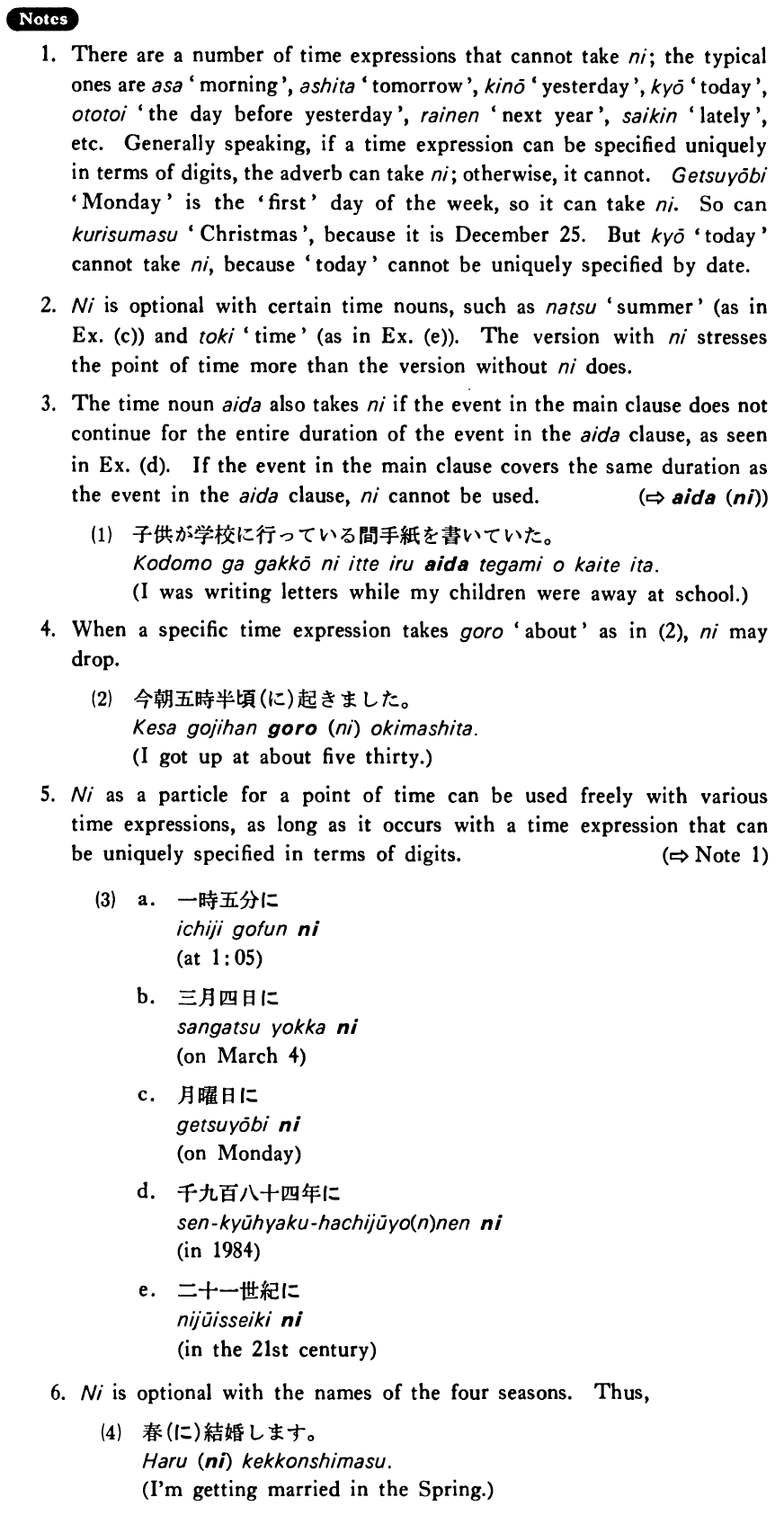
1. There are a number of time expressions that cannot take に; the typical ones are 朝 'morning', 明日 'tomorrow', 昨日 'yesterday', 今日 'today', 一昨日 'the day before yesterday', 来年 'next year', 最近 'lately', etc. Generally speaking, if a time expression can be specified uniquely in terms of digits, the adverb can take に; otherwise, it cannot. 月曜日 'Monday' is the 'first' day of the week, so it can take に. So can クリスマス 'Christmas', because it is December 25. But 今日 'today' cannot take に, because 'today' cannot be uniquely specified by date.
2. に is optional with certain time nouns, such as 夏 'summer' (as in Example (c)) and 時 'time' (as in Example (e)). The version with に stresses the point of time more than the version without に does.
3. The time noun 間 also takes に if the event in the main clause does not continue for the entire duration of the event in the 間 clause, as seen in Example (d). If the event in the main clause covers the same duration as the event in the 間 clause, に cannot be used.
(⇨ 間(に))
4. When a specific time expression takes ごろ 'about' as in (2), に may drop.
5. に as a particle for a point of time can be used freely with various time expressions, as long as it occurs with a time expression that can be uniquely specified in terms of digits.
(⇨ Note 1)
6. に is optional with the names of the four seasons. Thus,